

What is LoT and how is it developed? We live surrounded by smart devices. From the thermostat in the dining room to the clock that measures the quality of sleep. Indeed, all this is part of an ecosystem that is growing at great speed: the Internet of Things, or IoT (Internet of Things).
Now, how do these applications work? What processes are behind it for a sensor to be able to talk to a mobile app or an automated system? This is precisely where the development of IoT applications comes into play, a discipline that combines hardware, programming, usability and connectivity.
For agencies such as wwwarcelona, with an orientation towards strategic and digital design, understanding and participating in these environments is therefore key to offering connected and competitive solutions in today’s market.
How does an IoT application work?
An IoT application is not just a conventional app. Rather, it is a piece within a larger system that connects the physical world with the digital one.
Basic architecture
Generally speaking, operation can be divided into three essential levels:
- Smart device or node: such as sensors, cameras, or boards such as Arduino or Raspberry Pi.
- Cloud platform: which collects, stores and analyzes the data that arrives from the devices.
- User application: this can be a website or a mobile app from which data is viewed or actions are controlled.
For example, a temperature sensor sends information to the cloud. The user then sees it in the app and can set up alerts or automatic actions. This real-time data flow is undoubtedly the essence of the IoT.
Communication between devices
In terms of communication, IoT devices communicate through protocols such as MQTT, CoAP or HTTP, using technologies such as Wi-Fi, Bluetooth, Zigbee or LPWAN networks. Depending on the project, each use case determines which is the best option in terms of power consumption, range and speed.
Key components of IoT development
To understand how these applications are developed, you first need to know the fundamental blocks:
Sensors and actuators
On the one hand, sensors collect information: temperature, light, movement, pressure, etc. On the other hand, actuators perform actions such as turning on a light or opening a valve. Together, they are the interface with the physical world.
Microcontrollers and embedded systems
Platforms such as Arduino, ESP32 or STM32 are used to control the sensors and manage the connection with other devices. So, this is the heart of the IoT system.
Connectivity
Obviously, without an Internet connection, there is no IoT. Therefore, the choice between Wi-Fi, 4G, NB-IoT or LoRaWAN will depend on the location, battery need and data volume.
Cloud infrastructure
Finally, a fundamental part is the IoT backend, which processes and stores information. Platforms such as AWS IoT, Google Cloud IoT or Microsoft Azure allow scalable and secure systems to be developed.
Platforms and technologies for IoT
Cloud platforms
Currently, the main options include:
- AWS IoT Core: Massive scalability, ideal for industrial projects.
- Google Cloud IoT: Easy integration with analytics and AI systems.
- Azure IoT Hub: widely used in corporate environments due to its compatibility with Microsoft solutions.
Together, these platforms enable device authentication, event management, data storage, and action automation.
Languages and tools
As for the development of IoT applications, languages such as:
- C/C++ for embedded firmware, as it offers direct control over the hardware.
- Python or Node.js for servers and scripts, especially for its simplicity and speed of development.
- JavaScript, React Native or Flutter for connected mobile applications, which allow for a good cross-platform experience.
In this scenario, interface design (UI) and user experience (UX) play a crucial role when the user has to control devices or visualize complex data.
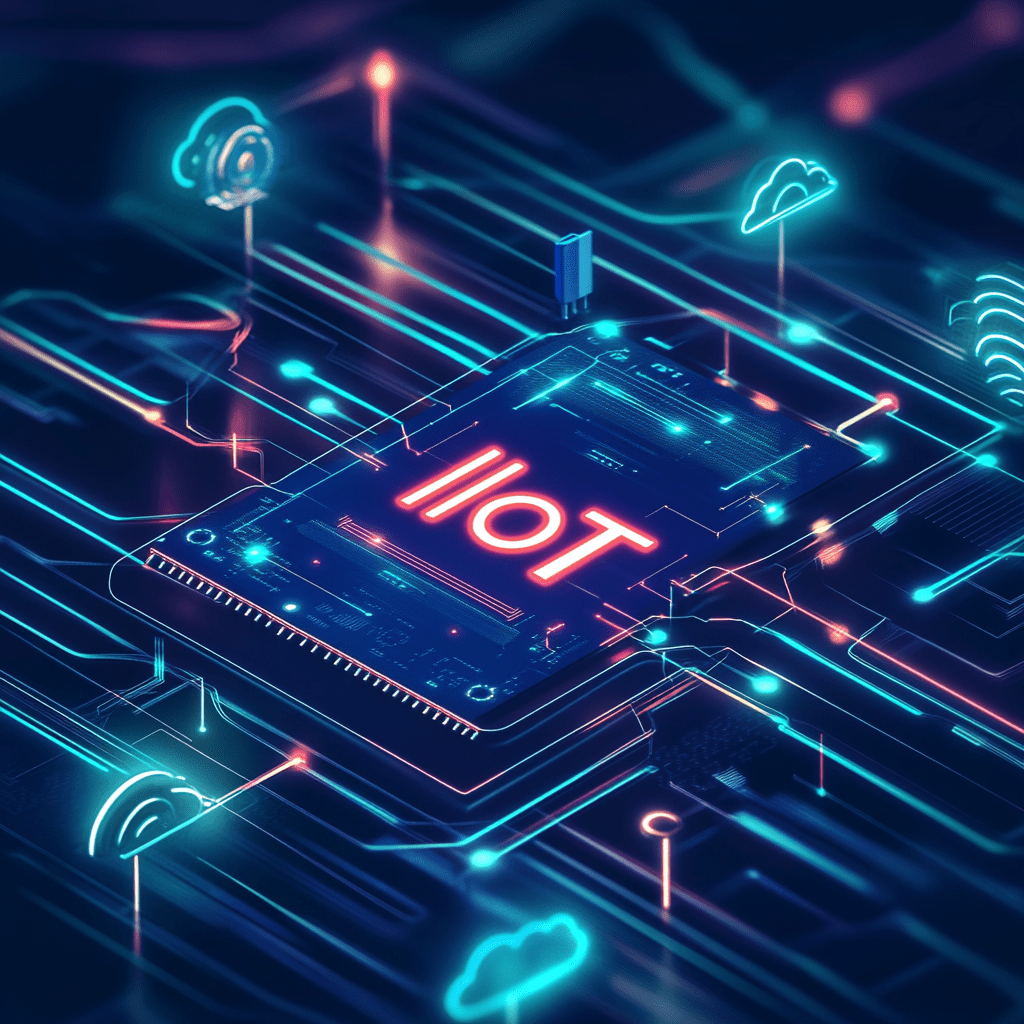
Stages of the development of an IoT application
The process of an IoT project follows several phases, similar but more complex than those of a traditional app.
1. Design and definition of requirements
As a first step, it all starts with understanding the problem to be solved. To do this, it is necessary to define what data needs to be collected, how it will be used and with which device or system it will be connected.
2. Prototyping the physical system
Then, with boards such as Arduino or ESP32, a functional prototype of the device is built. This allows the first operating hypotheses to be quickly validated.
3. Development of embedded software
In this phase, the behavior of the device is programmed: what it should do, how it connects and how it sends the information. This programming is key to ensuring reliability and efficiency.
4. Backend Development
At the same time, the server processes data, sends notifications, and manages smart rules. This layer ensures the logic and centralized control of the system.
5. Mobile or web app
Finally, the end user needs a clear and fast interface to control the system. The quality of this experience can make all the difference in product adoption.
At wwwarcelona, the development of digital products includes the alignment between technology and brand, thus creating complete experiences from functionality to the perception of value.
Real applications of IoT
The potential of IoT is almost limitless. Here are some key examples:
Smart home
For example, controlling lights, blinds, climate control and security systems from your mobile phone is now a reality. With Google Home or Alexa, you can also create automated scenes and routines.
Industry 4.0
In the industrial field, sensors in factories allow production to be monitored, predictive maintenance applied and remotely managed equipment. This increases efficiency and reduces downtime.
Health and wearables
In terms of health, bracelets, watches and connected medical devices collect user information and send it to the cloud to be analyzed or shared with medical professionals.
Smart mobility
Finally, in the mobility sector, we find electric bikes with GPS, traffic sensors or connected cars that optimize routes and report on the status of the vehicle in real time.
Challenges and considerations in IoT development
Despite its advantages, IoT comes with several important challenges that need to be addressed from the outset:
Security and privacy
First and foremost, every device is a potential gateway. For this reason, robust security protocols, encryption, and constant updates need to be applied.
Scalability
In addition, the system must be able to grow without losing performance. This implies, among other things, a solid infrastructure and a modular design that allows for progressive evolution.
Energy consumption
On the other hand, many devices run on batteries. Therefore, it is necessary to optimize consumption and study options such as low-power mode or the use of solar energy.
Interoperability
Finally, devices from different manufacturers must be able to communicate. In this sense, open standards such as Matter or MQTT play a fundamental role in ensuring efficient integration.
The Role of User Experience (UX) Design in IoT
While IoT is often talked about from a technical side, user experience design is essential to ensure effective and secure adoption.
Physical and digital interaction
For example, when a user presses a button in an app and waits for a door to open, everything must be immediate, clear and coherent. For this reason, UX in IoT requires designing with multiple contexts in mind: mobile, physical environment and visual or sound feedback.
Simplicity and confidence
In addition, when devices perform actions autonomously, it is critical for the user to understand what is happening and why. This understanding is resolved with clear interfaces, visible system states, and smart configuration options.
Conclusion and future prospects of IoT
IoT application development is a vibrant area, with great capacity for innovation and practical applications. In fact, from the home to the city, from healthcare to industry, connected systems are part of our present… and will define our future.
Therefore, companies that want to differentiate themselves need to understand that IoT is not only technology, but also experience, usability and trust. Therefore, having digital partners like wwwarcelona can make the difference between a simple application and a really useful and memorable solution.
